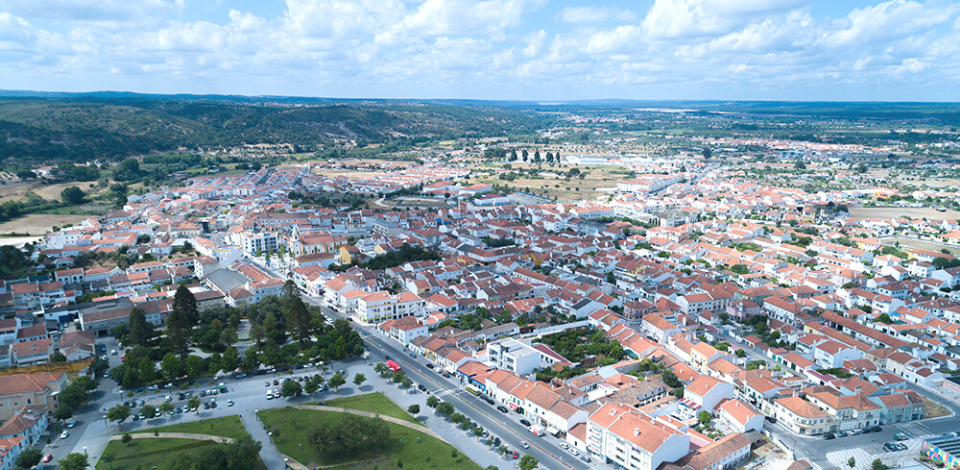
“The fiber-optic network will reach the parishes of Foros de Arrão, Galveias, and Montargil, nearby localities surrounding these parish centers, as well as Ervideira and Vale do Arco. Once the installation is completed—expected by the end of this year—around 95% of the municipality’s territory will be covered by this high-speed information technology network.”
“The fiber-optic network will reach the parishes of Foros de Arrão, Galveias, and Montargil, nearby localities surrounding these parish centers, as well as Ervideira and Vale do Arco. Once the installation is completed—expected by the end of this year—around 95% of the municipality’s territory will be covered by this high-speed information technology network.”
The guarantee was given to our newspaper by the Councillor for Culture, Environment, Tourism, and Administrative Modernization of the Municipality of Ponte de Sor.
Alda Falca explains that the new infrastructure serves two main purposes: bringing these localities closer to public administration services and, at the same time, strengthening the municipality’s goal of attracting further investment.
“Development is directly linked to technology. And if the municipality does not have the necessary technological communication infrastructure, it becomes not only very difficult to attract investment, but also—on another level—to provide good proximity services to the population,” she told Ecos do Sor.
The councillor recalls that until now, “fiber-optic infrastructure was limited to Ponte de Sor, Tramaga, Longomel, and part of Rosmaninhal.” However, she notes that “dstelecom, the company responsible for building the high-speed network in rural areas, included in its business plan the intention to provide more fiber-optic coverage in the municipality of Ponte de Sor.”
Aware of this decision, the Municipality met with the company to assess how joint efforts between both entities could ensure broader coverage across the territory.
“From an administrative modernization perspective, by bringing this high-speed communication network to more locations in the municipality, we will be able to increase both the number and the quality of the services we provide. Without fiber optics, it is impossible to consider, for example, the creation of Citizen Spaces, which allow residents to handle multiple Public Administration services,” she explains.
A Path Toward a New Relationship Between Citizens and Public Services
The installation of the high-speed network opens up a wide range of possibilities, starting with domestic use—once residents subscribe to TV and internet services offered by market operators. However, the councillor once again emphasizes the added value this new service brings to the relationship between citizens and Public Administration.
“We want to bring citizens closer to public services and make access easier. This relationship can currently be challenging due to geographical distance from the municipal headquarters for some localities and parishes. The goal is for people not to have to travel to the town hall building to deal with certain matters when they could do so from home via the internet.”
Another key advantage, she adds, is the potential for remote work:
“This is a reality that gained prominence worldwide due to the pandemic we are experiencing and has shown that, in many sectors, it is not necessary to be physically present at the workplace to carry out professional activities effectively and responsibly,” she told our newspaper.
Connected to the Information Highway
Alda Falca also highlights that the implementation of fiber optics “brings enormous potential for the use of new digital technologies,” which can be placed at the service of cultural development, among other areas.
“If we want to offer a digital augmented reality experience at a specific location, such as the Moinho de Foros de Arrão, we need the technology that makes it possible. Fiber optics are currently the best infrastructure available to achieve this. A whole new world opens up with this technology.”
She further notes that the Municipality has identified several points of interest from a cultural, tourism, and public services perspective, including Parish Councils, health extensions, cultural and tourism facilities, community centers, and elderly care homes.
“Until now, some of these facilities did not have access to a fiber-optic network,” she recalls.
Although Alda Falca considers it premature to set a definitive completion date for the network deployment, she states that the Municipality is making “every effort” together with dstelecom to ensure that it becomes a reality “by the end of this year.” Once the implementation works are completed, the municipality will be covered by approximately 140 kilometers of high-speed network.
Article published in Ecos do Sor.